

Here’s the complete rewritten article in text format:
A Public Feud Unfolds Between Two of the World’s Most Influential Leaders
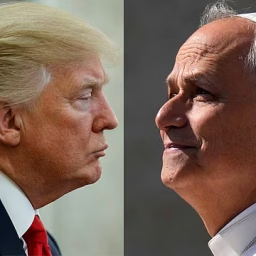
President Donald Trump has refused to back down from his criticism of Pope Leo XIV, dismissing calls for an apology even as tensions between the two leaders reached a boiling point. The clash marks a rare and dramatic moment when the heads of state power and religious authority find themselves at odds on the global stage.
During a press conference at the White House on Monday, Trump stood firm on his position, stating that the pope had opposed his administration’s approach to Iran and lacked the moral authority to weigh in on such matters.
THE CORE DISAGREEMENT: IRAN AND NUCLEAR AMBITIONS
At the heart of the dispute lies a fundamental disagreement over U.S. foreign policy toward Iran. Trump argues that preventing Iran from acquiring nuclear weapons is non-negotiable and essential to national security, while Pope Leo has consistently advocated for peace, dialogue, and diplomatic solutions to international conflicts.
When reporters asked Trump about his attacks on the pontiff, he did not hold back.
“He was very much against what I’m doing with regard to Iran, and you cannot have a nuclear Iran. Pope Leo would not be happy with the end result,” Trump explained. He went on to criticize the pope’s record on crime and other domestic issues, concluding firmly: “I’m not going to apologize.”
Trump emphasized that he was simply responding to the pope’s public statements, suggesting that Leo had initiated the exchange by speaking out first.
THE POPE’S PERSPECTIVE: FAITH-BASED APPEALS FOR PEACE
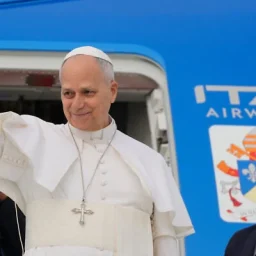
Hours before Trump’s combative remarks, Pope Leo had addressed the controversy while aboard a papal plane heading to Algeria. The pontiff rejected any comparison between Trump’s political agenda and the Gospel’s message of peace and reconciliation.
In a measured but pointed response, Leo told the Associated Press: “To put my message on the same plane as what the president has attempted to do here, I think is not understanding what the message of the Gospel is. I will continue on what I believe is the mission of the church in the world today.”
The pope made clear that his stance was not a personal attack on Trump or anyone else, but rather a reflection of his commitment to the church’s fundamental mission. He emphasized that he would continue to speak out loudly against warfare and in favor of peaceful solutions through dialogue and multilateralism.
“I’m not afraid of the Trump administration or of speaking out loudly about the message of the Gospel, which is what the Church works for,” Leo stated with conviction.
THE CONTROVERSIAL JESUS IMAGE: WHAT TRUMP ACTUALLY MEANT
Beyond the policy debate, the controversy intensified over a now-deleted social media post that depicted Trump in robes laying hands on a sick man in a manner reminiscent of biblical healing scenes. The image featured symbolic elements including eagles, an American flag, and heavenly imagery.
When confronted about the post, Trump offered an explanation that surprised many observers. He claimed the image was not meant to portray him as Jesus, but rather as a doctor working with the Red Cross to heal people.
“I did post it, and I thought it was me as a doctor and it had to do with the Red Cross,” Trump said. “It’s supposed to be me as a doctor, making people better. And I do make people better. A lot better.”
However, Trump blamed the media for any misunderstanding surrounding the post’s visual messaging. The image eventually disappeared from his social media account late Monday morning, though Trump never explicitly explained the reason for its removal.
THE BACKLASH AGAINST THE IMAGE
The image drew criticism from numerous quarters, including some of Trump’s own evangelical supporters who found the comparison to Christ troubling and inappropriate. Even international figures weighed in—Iran’s President Masoud Pezeshkian publicly condemned what he called a “desecration of Jesus” while simultaneously defending the pope against Trump’s attacks.
Vice President JD Vance, a Catholic who recently authored a book about his faith, defended Trump’s post as humor. He told Fox News Channel that the image was “a joke” and suggested Trump’s unfiltered social media presence is actually beneficial. Vance noted that Trump removed the post once he realized people weren’t interpreting it as intended humor.
ESCALATING TENSIONS: A DEEPER CONFLICT
The public feud didn’t emerge out of nowhere. On Sunday evening, Trump had launched an extended social media attack on Pope Leo while flying back to Washington from Florida. Upon landing, he continued his criticism, telling assembled reporters: “I’m not a fan of Pope Leo.”
The pope’s latest criticism stemmed from his Saturday prayer service at St. Peter’s Basilica, where he referenced what he called a “delusion of omnipotence” as the driving force behind conflict in the region. His comments coincided with the beginning of face-to-face negotiations between the United States and Iran in Pakistan during a temporary ceasefire.
Trump didn’t stop with vague criticism. In his social media posts, he directly attacked the pope’s fitness for his position.
“Pope Leo is WEAK on Crime, and terrible for Foreign Policy,” Trump wrote, adding: “I don’t want a Pope who thinks it’s OK for Iran to have a Nuclear Weapon.”
TRUMP’S BROADER CRITIQUE: QUESTIONING THE POPE’S LEGITIMACY
As the conflict deepened, Trump expanded his attacks far beyond foreign policy disagreements. He suggested that Leo’s selection as pope was motivated by politics rather than merit.
“Pope Leo is only elected pontiff because he was an American, and they thought that would be the best way to deal with President Donald J. Trump,” Trump claimed. He went further, stating: “If I wasn’t in the White House, Leo wouldn’t be in the Vatican.”
Trump concluded his critique by calling on the pope to refocus on spiritual matters rather than politics. “Leo should get his act together as Pope, use Common Sense, stop catering to the Radical Left, and focus on being a Great Pope, not a Politician. It’s hurting him very badly and, more importantly, it’s hurting the Catholic Church!” Trump wrote.
THE POPE’S CONSISTENT MESSAGE ON WAR
Pope Leo has made opposition to warfare a cornerstone of his spiritual leadership. In previous statements, he has invoked biblical passages to support his position, stating that God “does not listen to the prayers of those who wage war, but rejects them.” He has also quoted from Isaiah, declaring: “Even though you make many prayers, I will not listen — your hands are full of blood.”
This consistent stance on peace has clearly become a friction point with the Trump administration’s more aggressive foreign policy approach.
HISTORIC RARITY: WHEN POPE AND PRESIDENT COLLIDE
While disagreements between popes and presidents have occurred throughout history, it remains exceedingly rare for a pope to directly criticize a sitting U.S. president so publicly and clearly. Trump’s harsh response is equally uncommon and represents a departure from traditional diplomatic norms.
Archbishop Paul S. Coakley, president of the U.S. Conference of Catholic Bishops, expressed his dismay at the escalating conflict. In a formal statement, he emphasized the pope’s spiritual role and urged respect for his position.
“Pope Leo is not his rival; nor is the Pope a politician,” Coakley said. “He is the Vicar of Christ who speaks from the truth of the Gospel and for the care of souls.”
THE LARGER CONTEXT: SEVEN WEEKS OF WAR
This clash takes place as the United States continues military operations in Iran, now in its seventh week. The negotiations being conducted through Vice President Vance represent one potential avenue toward de-escalation, yet tensions at the highest levels of government and religious authority show no signs of easing.
LOOKING AHEAD: UNPRECEDENTED TERRITORY
The public feud between Trump and Pope Leo XIV represents uncharted waters in American political and religious discourse. With the pope beginning an 11-day visit to Africa and the Iran conflict continuing to dominate headlines, it remains unclear whether either leader will attempt reconciliation or continue their war of words.
What is certain is that this conflict has thrust fundamental questions about the proper roles of religious leaders and political figures into the public consciousness—and both sides appear unwilling to back down anytime soon.