

How Multiple Accusers Broke Through Fear and Silence to End a Political Career
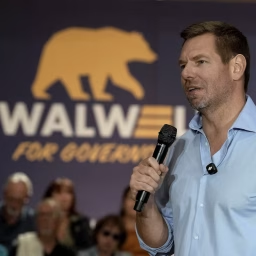
The fall of Rep. Eric Swalwell has come swift and decisive. Once a rising Democratic star with presidential ambitions, the California congressman announced his resignation from Congress on Monday—just one day after abandoning his bid to become the state’s next governor. Behind this stunning political collapse stands a powerful coalition of women who found courage in each other’s stories and refused to stay silent.
Two of Swalwell’s accusers spoke candidly with CBS News about what they describe as a watershed moment in their lives. While they celebrate what they see as vindication, both emphasized that true justice remains an ongoing battle.
“He was pushed into a corner, essentially, because they were planning to expel him,” said Ally Sammarco, whose accusations were first detailed in a CNN investigation. “But I also felt very vindicated that he realized it was over for him.”
Annika Albrecht, stepping into the public eye as an accuser for the first time, offered a more expansive view of what justice should entail. “For me, justice won’t be until he can’t ever harm a woman ever again, and he has faced the consequences for the women that he has harmed,” she told CBS News.
THE ALLEGATIONS THAT SPARKED A RECKONING
In recent weeks, Swalwell has faced serious accusations from multiple women detailing sexual misconduct that includes allegations of sexual assault, unsolicited explicit messages, and unwanted nude photographs. The allegations paint a troubling picture of a powerful man leveraging his position to pursue women who admired him professionally.
Swalwell has vehemently denied the accusations, characterizing them as false claims motivated by political opposition to derail his gubernatorial campaign. However, the accusers have firmly rejected any suggestion that their stories were coordinated attacks or part of a broader political strategy.
“We didn’t know each other before,” Sammarco explained. “I didn’t know any of the other women. We got connected through this process, and I’m so glad we did.”
THE TIMELINE OF COURAGE: FROM WHISPERS TO HEADLINES
The public reckoning unfolded in a remarkably compressed timeframe. Roughly two weeks before the allegations became public, Annika Albrecht reached out to Cheyenne Hunt, a longtime friend and social media influencer, asking her to share a personal video detailing her experience with Swalwell.
Albrecht said she felt physically compelled to act. “I felt physically sick and nauseous at the idea of Swalwell becoming governor of California,” she explained, describing the urgency that drove her decision to break her silence.
The next eleven days would prove transformative. “Eleven days is how long it took from when I reached out to [Cheyenne] to make the video to when the dam broke and all the articles were published,” Albrecht recalled. “They were the longest 11 days of our lives.”
Once Hunt posted her video online, the floodgates opened. She was immediately inundated with messages from other women sharing their own experiences with Swalwell. Within just two hours of posting, Hunt was on the phone with multiple accusers.
“I was immediately slammed with messages from other women accusing Swalwell of inappropriate behavior,” Hunt told CBS News. What emerged was deeply disturbing: one woman described what Hunt characterized as a “full-on assault.” This revelation shifted Hunt’s understanding of the situation’s gravity. “That was when I realized this was a lot bigger than any of us knew,” she said. “It was a different level of severity.”
CRIMINAL INVESTIGATION CONFIRMS SERIOUS ALLEGATIONS
The gravity of the accusations reached an official level when the Manhattan District Attorney’s Office confirmed it is investigating allegations against Swalwell. The investigation was prompted after the San Francisco Chronicle published a detailed report featuring accusations from an unnamed former staffer who described sexual assault incidents in both California and New York.
Swalwell denied these allegations and threatened legal action against the accuser. Hunt confirmed to CBS News that the alleged assault she was told about is entirely separate from the case being investigated by Manhattan prosecutors, suggesting the scope of misconduct allegations extends beyond what law enforcement is currently examining.
TWO WOMEN’S REMARKABLY SIMILAR EXPERIENCES
Both Albrecht and Sammarco described strikingly parallel encounters with Swalwell, each revealing a troubling pattern of behavior that suggests calculated manipulation.
Sammarco’s story began in 2021 when she was just twenty-four years old, working an entry-level campaign position for former Virginia Governor Terry McAuliffe. She initiated contact with Swalwell on Twitter, noting they shared similar backgrounds—both had grown up in households where their parents held Republican values. She assumed he would never even notice her message.
But he did. And he responded quickly.
“He said he wanted to help me further my career in politics,” Sammarco recalled. “I felt like a million bucks. I was thrilled, and I was flattered.”
The exchanges began innocently enough, with professional mentorship-focused conversations. But gradually, the tone shifted. Sammarco noticed messages she felt “had a weird connotation to them,” yet she hesitated to question the congressman’s intentions. “I trusted that he was an established figure who wouldn’t put his credibility on the line,” she said, illustrating how his position of authority suppressed her instinct to set boundaries.
Swalwell then suggested they communicate exclusively through Snapchat, a platform where messages vanish after being viewed. Sammarco found this request odd coming from a man in his forties who was married with children, yet fear of jeopardizing a valuable professional connection kept her compliant.
“The messages started out professional but then slowly became more explicit,” she said. Swalwell began sending her photos of his face, often while drinking, and would ask whether she was consuming alcohol or suggest they should have a drink together. One evening, he sent her an explicit photo of himself.
“I was shocked,” Sammarco said simply. “I don’t think I responded, and he changed the subject and moved on.”
ALBRECHT’S ACCOUNT: MENTORSHIP TURNED PREDATORY
Albrecht’s introduction to Swalwell came through a college class trip where she and fellow students met with the congressman to discuss policy issues they cared about. He appeared genuinely interested and passionate about their concerns, she said.
At the conclusion of their meeting, Swalwell asked the group to create a shared chat so he could continue the dialogue about these important issues. What happened next struck Albrecht as unusual and troubling: he added her—and only her—on Snapchat almost immediately afterward.
“I was really surprised. I was confused. I didn’t think it was him,” Albrecht said. When she asked the other students in the group whether Swalwell had similarly added them as Snapchat contacts, they said he had not. The significance was unmistakable: he had singled her out, and she was the only woman in the group.
Like Sammarco, Albrecht harbored professional ambitions in politics. Swalwell exploited this aspiration, framing their conversations as professional mentorship while offering guidance on achieving her dream of becoming a chief of staff.
“The Snapchat messages started to take a turn and they started to get flirty,” Albrecht said. She maintained what she described as “a platonic and professional manner” in her responses, hoping to redirect the conversation. But Swalwell persisted, escalating into sexually inappropriate content.
The situation reached a critical juncture when Swalwell invited her to a hotel meeting. “It was very clear what the connotation was,” Albrecht said. She did not respond to the invitation.
Reflecting on that moment, Albrecht expressed profound relief. The San Francisco Chronicle had reported on another woman’s account describing how, after going out for drinks with Swalwell in September 2019, she woke up naked in his hotel bed with no memory of how she arrived there. Swalwell denies this allegation.
“I keep thinking about how lucky I am that I didn’t go to that hotel,” Albrecht said. “It was terrifying to get on the phone with those women and hear their stories about how they were drinking with him and suddenly woke up in bed next to him with no recollection of how they got there.”
THE PATTERN EMERGES: A PREDATOR EMBOLDENED BY POWER
Sammarco articulated what the accusations reveal about Swalwell’s mindset and behavior. “He thought he was untouchable. He acted with total impunity. He never thought that the consequences of his actions would follow him,” she said.
The full scope of his misconduct remained hidden in part because of his power and position. Hunt disclosed that she had been warned about Swalwell years earlier while working on Capitol Hill through what she called a “whisper network”—informal warnings passed among staffers.
“People told me, ‘Stay away from Swalwell. Do not engage with him on social media. Do not be alone with him,'” Hunt recalled.
Yet his behavior continued unchecked for years, possibly emboldening him further. Sammarco theorized that his ability to run for president without facing consequences intensified his sense of invulnerability.
“He ran for president and nothing came out about him. So I think that empowered him to continue doing what he was doing,” she said. “As governor, he would have had even more power and more authority. And he would have felt vindicated too, that he could run for higher office.”
THE STAGGERING SCOPE: THIRTY WOMEN AND COUNTING
The scale of the accusations extends far beyond the public narratives shared by Sammarco and Albrecht. Hunt revealed that more than thirty women have contacted her with some form of misconduct accusation against Swalwell since she posted her initial video sharing her story online. Hunt has also heard similar accounts of sexual assault from two women involving allegations of memory loss after drinking with him.
This number suggests a pattern rather than isolated incidents—a sustained pattern of predatory behavior spanning years and targeting numerous women.
THE WORK AHEAD: JUSTICE REMAINS INCOMPLETE
Despite Swalwell’s announced resignation, the accusers have expressed cautious concern about whether he will truly exit Congress quickly. Albrecht noted that his resignation statement leaves open the possibility he could remain in his seat for some time.
“I want to see him out now,” she said firmly.
For Sammarco, the political hypocrisy cuts particularly deep. “He gave off this perception that he was a family man. That he was a fighter. That he was a defender of women. And that couldn’t be further from the truth,” she said. “If these are the people that are out there championing women and, you know, protectors of women, and ‘We need to hold people accountable,’ and then behind closed doors they’re doing this—that is a huge discrepancy for anybody who’s working in politics.”
Hunt struck a note of solidarity while sounding an alarm about the broader environment. “The women who have come forward have been embraced and their bravery is being so greatly respected,” she said. But she added a crucial caveat: “This fight is not over. We’re just getting started. It’s clear that there needs to be another reckoning.”
THE LARGER CONVERSATION: A WATERSHED MOMENT
The fall of Eric Swalwell marks a pivotal moment in how power, misconduct, and accountability intersect in American politics. These women chose to speak publicly despite the personal cost, professional risks, and emotional toll of revisiting traumatic experiences. Their collective action has achieved something many thought impossible—the resignation of a sitting congressman.
Yet as Albrecht and Sammarco have made clear, this outcome is not an ending. It is merely a beginning. The systems that protected Swalwell for years remain largely unchanged. The culture that enabled his behavior persists. And as Hunt’s revelation of thirty-plus accusers demonstrates, there is much more work ahead.
The women who brought down Rep. Eric Swalwell have demonstrated that silence can be broken and that accountability, however partial and delayed, remains possible. Their message to others considering coming forward is clear: your story matters, and you are not alone.