


Now presenting the article in text format:
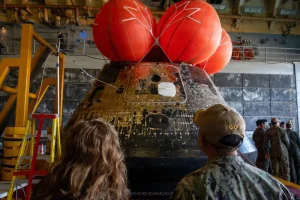
The U.S. Navy provided an unforgettable homecoming for four space explorers who had just completed humanity’s most ambitious journey beyond Earth in over fifty years. As the Orion spacecraft splashed down in the Pacific Ocean approximately fifty miles off San Diego’s coast last Friday, Navy personnel aboard the USS John P. Murtha became the first people to welcome the Artemis II crew back to Earth following their extraordinary ten-day mission around the moon.
A HISTORIC MISSION RETURNS HOME
The Artemis II mission represents a watershed moment in human space exploration. For the first time since the Apollo era, NASA successfully sent astronauts on a journey into deep space—traveling to lunar orbit and back in the innovative Orion spacecraft. The mission proved that decades of engineering, planning, and technological development have positioned humanity to return to the moon with confidence and capability.
The Four Astronauts on This Extraordinary Journey
The crew comprised experienced space explorers and pioneers. NASA astronauts Victor Glover, Christina Koch, and Reid Wiseman joined Canadian Space Agency astronaut Jeremy Hansen aboard the Orion capsule. Their ten-day voyage took them farther from Earth than any human has traveled in the modern space age, demonstrating the remarkable progress in spacecraft design and mission planning since the end of the Apollo program.
A Perfect Splashdown in the Pacific
The Orion spacecraft executed a textbook splashdown in designated waters off San Diego, allowing the Navy to conduct a precisely coordinated recovery operation. The location—approximately fifty miles from the California coast—had been planned meticulously to ensure that recovery assets could reach the crew quickly while maintaining appropriate safety margins.
THE NAVY’S CRITICAL ROLE IN MISSION SUCCESS
While astronauts garnered the headlines, the U.S. Navy played an equally essential role in the mission’s success. The amphibious transport dock USS John P. Murtha, a San Antonio-class vessel, served as the command center and primary recovery platform for the entire operation.
Specialized Teams Ready for Action
The Navy’s preparation for this mission involved months of training and coordination. Specialized dive teams from Explosive Ordnance Disposal Group ONE (EODGRU-1) trained extensively to manage the recovery of both the crew and the sophisticated Orion spacecraft. These divers are among the most highly trained personnel in the U.S. military, accustomed to operating in challenging maritime conditions while managing complex recovery operations.
The Helicopter Sea Combat Squadron Twenty-Three (HSC-23) operated Navy MH-60S Seahawk helicopters that provided rapid transportation of crew members from the splashdown site to the USS John P. Murtha. The coordination between divers, helicopter crews, and ship personnel required precision timing and flawless communication.
A Choreographed Operation
The recovery operation itself was a masterpiece of military coordination. Divers launched from the well deck of the USS John P. Murtha to reach the Orion capsule and secure the crew for helicopter extraction. Within hours of splashdown, all four astronauts had been safely transported aboard the Navy ship, where medical personnel conducted comprehensive health evaluations to assess their condition following their extended stay in microgravity.
MOMENTS OF JOY AND CELEBRATION
The Navy’s photo documentation of the recovery operation captured the profound human emotion of this historic moment. Images show the astronauts emerging from the helicopters, relief and joy evident on their faces as they stepped onto the flight deck of the USS John P. Murtha.
The Reunion with Mission Control
As the astronauts walked across the flight deck, they were greeted by NASA personnel and Navy sailors who had supported their mission. The exchanges visible in the photographs convey genuine celebration—these space explorers had accomplished what many thought impossible and had returned safely to Earth.
Moments of Individual Triumph
Photographs document individual astronauts celebrating their safe return. Victor Glover stands on the flight deck with arms raised in triumph. Reid Wiseman converses with NASA personnel, still processing the extraordinary experience of having traveled to the moon and back. Christina Koch and Jeremy Hansen posed together, their expressions reflecting the shared experience of having journeyed farther from Earth than any humans in five decades.
The Golden Hour Backdrop
The Navy released photographs showing the crew boarding the USS John P. Murtha bathed in the golden light of sunset across San Diego. These images captured not just the practical achievement of a successful recovery but also the poetic beauty of the moment—humanity’s representatives returning from space framed against the warm light of an Earth sunset.
THE VESSEL AT THE CENTER OF RECOVERY
The USS John P. Murtha emerged as a critical piece of infrastructure for this mission. The San Antonio-class amphibious transport dock is specifically designed for operations that require sophisticated command and control capabilities, helicopter operations, and accommodation for specialized teams.
A Ship Designed for Complex Operations
The USS John P. Murtha features a well deck that allows divers and specialized teams to launch and recover directly from the vessel. This feature proved essential for managing the recovery of both the Orion spacecraft and the crew. The ship’s flight deck accommodates multiple helicopters operating simultaneously, allowing for rapid transport of personnel and coordination of complex operations.
Homeport in San Diego
Based at Naval Base San Diego, the USS John P. Murtha was ideally positioned to support the Artemis II recovery. Following completion of the recovery operation, the ship returned to its home port on April 11, 2026, entering the harbor with the knowledge that it had played a vital role in one of humanity’s greatest achievements.
MILITARY-CIVILIAN PARTNERSHIP IN SPACE EXPLORATION
The Artemis II recovery operation exemplifies the deep partnership between NASA and the U.S. military, particularly the Navy. While NASA manages the scientific and engineering aspects of space exploration, the military provides essential infrastructure, personnel, and logistical support.
Decades of Collaboration
This partnership extends back to the origins of human spaceflight. Military test pilots and engineers have been central to space exploration since the beginning of the American space program. The Navy’s expertise in maritime operations, logistics, and personnel recovery made it the natural choice to manage the splashdown and recovery aspects of Artemis II.
Specialized Training and Expertise
Navy personnel dedicated considerable resources to preparing for this mission. Divers trained in the specific procedures required to safely extract astronauts from the Orion capsule in ocean conditions. Helicopter pilots practiced precision insertions and extractions. Medical teams studied the physiological challenges astronauts face after extended exposure to microgravity.
A Blueprint for Future Missions
The successful recovery of the Artemis II crew establishes operational procedures and expertise that will guide future deep-space missions. As NASA prepares for sustained lunar exploration and eventually human missions to Mars, the Navy’s role in supporting these endeavors will only become more critical.
BROADER SIGNIFICANCE OF THE ARTEMIS II SUCCESS
Beyond the immediate achievement of bringing four astronauts safely home, Artemis II represents a turning point in humanity’s relationship with space exploration.
Proving Readiness for Sustained Lunar Operations
The success of Artemis II demonstrates that NASA possesses the technical capability to routinely send humans into deep space and bring them safely home. This achievement provides the foundation for more ambitious missions, including sustained lunar operations and the eventual landing of astronauts on the lunar surface.
Restoring American Leadership in Space
For over fifty years, no nation had sent humans beyond low Earth orbit. The successful completion of Artemis II reestablishes American leadership in deep-space exploration and signals a renewed commitment to ambitious space goals.
International Collaboration in Space
The inclusion of Canadian Space Agency astronaut Jeremy Hansen on the Artemis II mission underscores the international nature of modern space exploration. While competition between nations continues in other domains, space exploration increasingly represents a collaborative human endeavor.
A New Generation of Space Explorers
The Artemis II crew represents a new generation of space explorers. Christina Koch, Victor Glover, Reid Wiseman, and Jeremy Hansen bring diverse backgrounds and perspectives to space exploration. Their successful mission opens doors for future astronauts and inspires a new generation of scientists, engineers, and explorers.
THE PHOTOGRAPHS TELL THE STORY
The Navy’s release of detailed photographs from the recovery operation preserves this historic moment for posterity. These images document not just the technical achievement but the human drama of space exploration.
From Launch to Recovery
The photographs chronicle the entire recovery process—from divers preparing to launch from the USS John P. Murtha, to the Orion capsule being recovered from the ocean, to the astronauts emerging from helicopters and walking across the flight deck. Collectively, these images tell the complete story of a successful mission and a safe return.
Historical Documentation
Future generations will view these photographs to understand how the Artemis II mission concluded and what the return to deep-space exploration looked like. The images capture the professionalism of the Navy personnel involved, the joy of the astronauts, and the scale of the achievement.
LOOKING FORWARD: ARTEMIS III AND BEYOND
The successful completion of Artemis II sets the stage for even more ambitious missions. NASA has already begun preparations for Artemis III, which will attempt to land astronauts on the lunar surface for the first time since 1972.
Building on Success
The procedures and expertise demonstrated during Artemis II will directly inform how NASA and the Navy prepare for Artemis III. Each mission builds institutional knowledge and refines operational procedures.
The Path to Sustained Lunar Exploration
Artemis III is envisioned as the beginning of a sustained human presence on the moon rather than a single landing. Multiple missions will follow, establishing research stations and conducting scientific investigations that will inform humanity’s eventual expansion to Mars.
The Ultimate Goal: Mars
While the moon represents the immediate focus, the longer-term goal remains clear: human exploration of Mars. The Artemis program serves as the bridge between Earth-orbit operations and the far more ambitious challenge of sending humans to another planet.
CONCLUSION: A MOMENT WORTH CELEBRATING
The safe recovery of the Artemis II crew by the U.S. Navy represents more than just a successful mission. It symbolizes humanity’s capacity to dream ambitiously, to build remarkable machines, and to accomplish extraordinary feats through dedication and expertise. As the four astronauts emerged from the Pacific Ocean and stepped aboard the USS John P. Murtha, they carried with them proof that the next great era of space exploration has begun.
