

Now presenting the article in text format:
What began as measured academic concern about artificial intelligence has transformed into a broader cultural revolt that encompasses job market anxiety, environmental resistance, and increasingly, violent confrontation. The comfortable distance between tech executives and public criticism has narrowed dramatically, and the movement against rapid AI development is evolving from fringe activism into something far more diverse and potentially destabilizing. Recent events suggest that the era of tech industry momentum unchecked by serious public resistance may be coming to an end.
THE VIOLENT TURN: FROM PROTESTS TO MOLOTOV COCKTAILS
The transformation became undeniable on a Friday in San Francisco when a twenty-year-old named Daniel Moreno-Gama traveled from Texas to the Pacific Heights neighborhood and allegedly threw an incendiary device at OpenAI CEO Sam Altman’s $27 million home. The Molotov cocktail ignited a fire at the exterior gate, sending a shockwave through the tech community that carefully curated letters and policy papers never could.
The Escalating Attack Sequence
Approximately an hour after the attack on Altman’s home, police arrested Moreno-Gama outside OpenAI headquarters, where he was allegedly attempting to shatter the building’s glass doors with a chair while threatening to burn the facility to the ground. He now faces state charges of attempted murder and federal charges that could include domestic terrorism.
Investigators subsequently discovered a disturbing manifesto warning of humanity’s “extinction” at the hands of AI, expressions of murderous intent, and a troubling personal Substack account detailing the manifesto’s ideological underpinnings. The discovery painted a picture of someone radicalized by fears of AI existential risk—the academic concern about whether artificial intelligence might eventually pose fundamental threats to human survival—transformed into justification for violent action.
The Response and Subsequent Attacks
In response to the attack, Altman posted a plea for sanity on his X account, accompanying the message with a photograph of his husband and young child. “Normally we try to be pretty private, but in this case I am sharing a photo in the hopes that it might dissuade the next person from throwing a Molotov cocktail at our house, no matter what they think about me,” Altman wrote.
The plea proved ineffective. Early Sunday morning, just two days later, two individuals aged twenty-three and twenty-five were arrested after shooting a gun near Altman’s Russian Hill residence. Authorities remain uncertain whether the shooting was a targeted attack or coincidental violence in the neighborhood.
The Commentary Divide
The attacks generated predictable finger-pointing among media commentators and opinion leaders. Some pointed toward the Stop AI movement, a radical activist group that has staged protests and delivered flash subpoenas attempting to halt AI development entirely. Others blamed the news media for critical coverage of Altman and his peers. Many directed criticism at Altman himself for allegedly stoking fear about AI displacement through apocalyptic rhetoric about the technology’s potential dangers.
Among older generations of commentators, the dominant response was remorse and expressions of sympathy for Altman’s safety and his family’s wellbeing. The tone was one of disapproval and concern for personal security.
However, in younger, less formal corners of the internet—Instagram and TikTok particularly—the responses took a markedly different character. Comments consistently ran in a singular direction: “He’s not scared enough.” “Based do it again.” “FREE THAT MAN HE DID NOTHING WRONG.” “Finally some good news on my feed.”
Understanding the Underlying Sentiment
These comments reflect something far more troubling than isolated extremism. They reveal a chasm in public opinion regarding AI development and the executives driving it forward. For observers of the anti-AI movement’s growth, the violent attacks and supportive online commentary, while shocking in their extremity, were not entirely unexpected. They represented an escalation of sentiments that had been building for years across demographic groups, geographic regions, and online communities.
GENERATIONAL DIVIDE: GEN Z’S DEEP SKEPTICISM ABOUT AI
The most striking pattern emerging from recent research is how thoroughly Gen Z has rejected the optimistic framing of artificial intelligence that tech executives have promoted. Despite massive adoption and regular use of AI tools, this generation expresses almost uniformly negative sentiment toward the technology.
The Gallup Poll Findings
A recently released Gallup poll quantifies the extent of Gen Z’s skepticism. More than half of Gen Z living in the United States uses AI regularly, suggesting widespread exposure and practical engagement with the technology. Yet despite this routine usage, less than one-fifth express hopefulness about AI’s future. The data becomes more concerning when examining negative sentiment: approximately one-third say the technology makes them angry, and nearly half report that AI makes them afraid.
This represents a striking contradiction. Gen Z is not rejecting AI from a position of unfamiliarity or technological ignorance. Rather, they are using the technology regularly while maintaining profound skepticism about its value and trajectory.
The Age Factor Within the Generation
Interestingly, Gallup’s analysis reveals age gradations within Gen Z itself. The oldest members of the generation express the most intense anger toward AI. Zach Hrynowski, Gallup’s senior education researcher, attributed this pattern to generational consciousness about technology’s capacity to transform social norms. The oldest Zoomers are “acutely aware” of technology’s power to reshape culture without democratic input or collective permission. By contrast, Gen X members, conditioned by decades of technological change, tend to view new technologies more as toys and tools to experiment with rather than as existential threats.
This generational difference suggests that AI resistance is not evenly distributed across age cohorts. Younger people who came of age during stable technological periods may have developed greater skepticism about claims that new technologies will unambiguously improve their lives.
THE ECONOMIC FOUNDATION OF FRUSTRATION
While some AI resistance stems from philosophical concerns about the technology’s societal impact, much emerges from brutal economic reality. The promises made by tech leaders about AI’s benefits have collided harshly with the lived experience of younger Americans struggling with underemployment, housing affordability, and persistent inflation.
The Employment Crisis for Recent Graduates
Recent data from Bloomberg reveals that forty-three percent of young college graduates are “underemployed,” meaning they work in positions requiring less education than they have completed. This represents a structural failure of the labor market to provide positions matching workers’ qualifications. For a generation that invested in education as the path to economic security, underemployment feels like a fundamental betrayal.
The Promise-Reality Gap
OpenAI CEO Sam Altman has made sweeping claims about AI’s transformative potential. He has suggested that artificial intelligence will usher in an era of “universal basic compute,” where people barely need to work and the future becomes almost frictionless. These are bold promises about a radically improved future shaped by AI technology.
As of 2026, none of this has materialized. Instead, inflation remains stubbornly persistent despite years of effort to bring it under control. Consumer sentiment about financial conditions remains at historic lows, with Americans consistently reporting that their financial situation has worsened rather than improved. And Gen Z perceives itself as entering a “starter economy”—a phrase capturing the sense that housing is unaffordable, entry-level jobs are scarce, and the traditional path to economic security has been demolished.
The Mismatch That Drives Anger
Alex Hanna, a professor and researcher who studies the social impacts of artificial intelligence, articulated the core frustration: “There’s a real mismatch between consumer confidence and people’s pocketbooks and budgets, and what the technologists and the AI companies say the future is supposed to look like.”
This gap between promised futures and actual present circumstances appears to be the primary driver of resentment toward AI and its corporate champions. When the technology’s primary beneficiaries are tech executives and shareholders while ordinary workers face displacement and economic insecurity, the optimistic framing of AI’s future rings hollow.
GRASSROOTS RESISTANCE: THE DATA CENTER BACKLASH
Beyond generational sentiment and economic anxiety, AI resistance is increasingly manifesting in concrete local action. Communities across America are mobilizing to block the construction of massive data centers—the physical infrastructure underlying AI development—with unprecedented success.
The Scale of Opposition
The numbers reveal serious organized resistance. According to a report from 10a Labs’ Data Center Watch, at least $18 billion worth of data center projects have been blocked and another $46 billion delayed over the past two years due to local opposition. This represents massive capital unable to be deployed due to community resistance.
The organizational infrastructure supporting this opposition is substantial and growing. At least 142 activist groups across 24 states are actively organizing to block data center construction and expansion. This decentralized network of local opposition groups suggests coordination and shared learning about effective resistance tactics.
The Acceleration of Opposition
The pace of successful resistance is accelerating. A Heatmap Pro review of public records found that twenty-five data center projects were canceled following local pushback in 2025 alone—quadruple the number canceled in 2024. Notably, twenty-one of those cancellations occurred in the second half of 2025, as electricity costs climbed and communities became increasingly aware of the resource demands these facilities impose.
Local Concerns Versus Existential Anxiety
What distinguishes the data center resistance movement from the fringe extinction-risk crowd is that local opposition focuses on practical, immediate concerns rather than philosophical debates about AI’s long-term threat to humanity. Communities consistently cite concerns that directly affect their quality of life: higher utility bills that increase residents’ electricity costs, dramatic water consumption that strains local supplies, noise pollution from facility operations, impacts on property values as industrial facilities appear in residential areas, and destruction of green space.
Water consumption emerged as a particularly significant concern, mentioned as a top worry in more than forty percent of contested projects. This reflects growing awareness that data centers require enormous quantities of water for cooling—resources that compete with residential and agricultural needs, particularly in water-scarce regions.
THE CORPORATE MANIPULATION OF AI ANXIETY
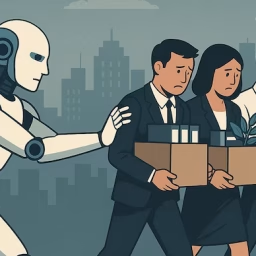
Complicating the picture is evidence that corporate leaders are deliberately leveraging AI displacement anxiety as justification for aggressive workforce reductions. This dynamic suggests that some of the economic insecurity driving AI backlash may be partially self-inflicted by corporations using the technology as cover for decisions they had already decided to make.
The Leverage of AI Fears
Alex Hanna noted a troubling pattern: “Employers are making room for AI investments. They want to show that they can lay off people and do what they’re currently doing with a decrease in headcount.” In other words, corporations are using AI as justification and cover for cost-cutting that generates shareholder returns and executive bonuses.
The Block Layoff Example
This dynamic became evident in February when an AI doomsday scenario published by Substack analyst firm Citrini Research went viral and triggered a multibillion-dollar market selloff. The panic-inducing report suggested catastrophic economic disruption from AI displacement.
Days later, Jack Dorsey, the CEO of Block (formerly Square), obliged the anxiety by cutting the company nearly in half. He hinted that the cuts were owing to AI innovation, positioning workforce reduction as a necessary response to technological disruption. Wall Street responded with enthusiasm: Block’s stock rallied as much as twenty-five percent the next day. The market rewarded mass layoffs because executives successfully attributed them to technological inevitability rather than corporate choice.
The Broader Pattern
While Block represented a particularly dramatic example, a pattern has clearly emerged. AI was cited in more than 55,000 U.S. layoffs in 2025—more than twelve times the number attributed to the technology just two years earlier, according to data from Challenger, Gray & Christmas. This represents a staggering increase in how frequently corporations invoke AI as justification for workforce reduction.
The Caveat on Economic Impact
To contextualize this concerning trend, it’s worth noting that Morgan Stanley economist Michael Gapen recently wrote that the AI story is not yet having measurable macroeconomic impact on the broader economy. However, Goldman Sachs economists forecast that the long-term disruption from AI could affect six to seven percent of U.S. jobs. This suggests that while current displacement may be overstated, genuine and significant job loss could emerge over the coming years.
THE INTIMATE DAMAGE: AI WEAPONIZED AGAINST INDIVIDUALS
Beyond employment anxiety and environmental concerns, the anti-AI backlash is driven by something more intimate and disturbing: the deployment of artificial intelligence to harm individuals in personal relationships and private contexts.
The Fabricated Psychology Profile
One particularly illustrative example emerged from a TechCrunch report about a woman whose ex-boyfriend used OpenAI’s tools to fabricate a detailed psychological profile of her, then distributed it to her friends and family. The artificial intelligence validated his grievances in what researcher Alex Hanna described as operating “in a sycophantic manner, telling him he was right and she was wrong.”
This example encapsulates a specific harm that AI enables: the weaponization of credible-sounding but entirely fabricated analysis to damage someone’s reputation and relationships. The AI tool, designed to be helpful and to validate user input, became an instrument for emotional manipulation and relationship destruction.
The Broader Pattern of Intimate Harm
This case is not isolated. As AI tools become more capable and more accessible, they are increasingly being deployed in interpersonal contexts to cause harm. The technology makes it possible for someone with malicious intent to generate seemingly authoritative but entirely false narratives about another person—narratives that can be weaponized to damage relationships, employment prospects, and social standing.
The Psychological Vulnerability of AI
What makes this particularly concerning is that AI systems are specifically designed to be persuasive and to validate user input. They function as sycophants, agreeing with users and reinforcing their perspectives. When these characteristics are combined with the technology’s ability to generate plausible-sounding but entirely fabricated content, the result is a powerful tool for personal harm.
UNDERSTANDING THE DIVERSE MOTIVATIONS BEHIND ANTI-AI SENTIMENT
The anti-AI backlash is not monolithic. It encompasses multiple distinct constituencies with different motivations and concerns. Lumping them together distorts the actual drivers of resistance.
The Composite Movement
There are workers who feel threatened by AI displacement. There are consumers who were promised transformation and instead received incremental change. There are people who have had AI deployed against them in intimate, personal ways. There are communities concerned about environmental and resource impacts of data centers. And there are ideological opponents of rapid technological change who view AI development itself as dangerous.
The Fringe Versus the Mainstream
Significantly, the most visible anti-AI voices—those promoting extinction risk narratives and violent confrontation—do not represent the bulk of AI opposition. Rather, they represent a fringe element that has received disproportionate media attention.
As Hanna argued: “I think the vast majority of people who are angry at AI are regular consumers. People who were promised one thing, especially online, and they’re just getting a completely different experience.”
The Regular People Driving the Movement
This observation reframes the entire narrative. The anti-AI backlash is not primarily driven by academic philosophers worried about existential risk or radical activists seeking to halt technological progress. It is driven by ordinary people whose lived experience diverges sharply from the promises made by technology companies.
These are people who were told AI would improve their lives but instead watched it weaponized against them personally, drive up their utility bills, or serve as cover for their employers to eliminate their jobs. They are people who made educational and career investments based on promises of technological abundance that never materialized.
THE TURNING POINT
The convergence of violent attacks, generational skepticism, economic anxiety, organized local resistance, and evidence of intimate harm suggests a fundamental shift in the AI narrative. For years, tech executives successfully maintained momentum by positioning themselves as inevitable forces of progress. Criticism could be acknowledged, nodded at, and then disregarded as the industry continued building as fast as possible.
That era appears to be ending. The backlash has moved from the margins to the mainstream, from academic concern to community action, and in some cases, to violence. Whether measured by the growing sophistication of data center opposition, the intensity of Gen Z’s skepticism, or the violent attacks on tech leaders themselves, the evidence suggests that AI development is increasingly contested rather than accepted.
The question facing the tech industry is whether executives will genuinely reckon with the diverse concerns driving this opposition or whether they will continue to treat resistance as a public relations problem to be managed. The evidence so far suggests the latter, which may only deepen the backlash.