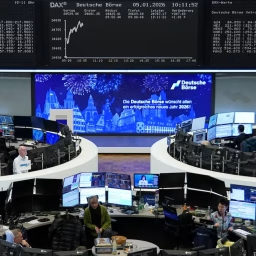


Asia Pacific Markets Rally Amid Venezuela Crisis as Brent Crude & WTI Oil Prices Fluctuate
Asia Pacific financial markets opened higher on January 5, 2026 despite elevated geopolitical risk after the United States carried out military operations in Venezuela and captured President Nicolás Maduro. Regional equities climbed while oil prices Brent crude and WTI oil displayed mixed behavior as investors weighed geopolitical upheaval alongside economic fundamentals.
Here’s a comprehensive breakdown of how Asia Pacific markets reacted to the Venezuela crisis, the implications for commodities such as Brent crude and WTI oil prices, and what investors should watch in the coming sessions.
Major Moves in Asia Pacific Markets
-
Equities Extend Gains: Asian markets, including Japan’s Nikkei 225 and South Korea’s Kospi, rallied strongly as investors appeared to look past geopolitical turmoil. Japanese stocks advanced significantly, with the Kospi also hitting notable gains. Business Standard
-
Hang Seng Index Mixed: Hong Kong’s market showed relative stability even as regional indices extended gains, suggesting that investor appetite for risk assets remains resilient. MarketPulse
-
Market Resilience: Core Asia Pacific equity benchmarks opened on a positive note, with broader indices showing strength despite global uncertainty. LinkedIn
These equity gains indicate that risk sentiment among investors remains broadly positive, driven in part by optimism around economic data and strategic sector strength.
Brent Crude & WTI Oil Price Movement
Volatile But Not Surging
-
Brent crude prices displayed mild fluctuations, initially dipping before stabilizing as markets digested the emerging developments in Venezuela. LinkedIn
-
WTI oil also experienced choppy behavior, with prices wavering within a narrow range as traders assessed both geopolitical risk premiums and broader supply fundamentals. Business Standard
-
The limited impact on oil prices aligns with analyst views that global oil markets remain well supplied, and Venezuela’s output represents a relatively small share of total global supply despite its large reserves. Wikipedia
Market analysts had previously forecast that Brent crude and WTI oil prices would come under pressure throughout 2026 due to an oversupplied market and subdued demand growth. Reuters
Geopolitical Context: Venezuela and Oil Markets
The political upheaval in Venezuela—following U.S. intervention and the arrest of President Maduro—adds a new geopolitical risk factor for commodities and financial markets. However:
-
Venezuela produces a relatively small portion of crude output (~1% of global production), even though it holds significant reserves. Wikipedia
-
Analysts continue to argue that oil market fundamentals, including oversupply, remain dominant drivers of Brent crude and WTI price dynamics, which may temper volatile price spikes associated with geopolitical events. Reuters
The contrast between strong reserves and low current output suggests that market participants are watching for future supply changes, though any recovery in Venezuelan production would likely be gradual. energynews.oedigital.com
Safe-Haven Flows & Cross-Asset Sentiment
In response to rising geopolitical tensions:
-
Safe-haven assets, such as gold, experienced notable demand as traders looked to hedge against uncertainty. TechStock²
-
Currencies like the U.S. dollar maintained strength, backed by ongoing macro expectations and geopolitical risk pricing. Business Standard
-
Digital assets, including Bitcoin and ether, also saw small gains, indicating diversified risk positioning among investors. Business Standard
This divergence in cross-asset behavior—where commodities like oil and gold respond differently to the same geopolitical event—highlights how modern markets are multifaceted in assessing risk.
What This Means for Investors
Equity Opportunities
-
Strong performance from stocks like technology and industrial sectors drove regional indices upward. Investors may see continued opportunities if fundamentals stay intact and central bank policies remain accommodative.
Oil Price Implications
-
Traders should monitor Brent crude and WTI oil prices not just for geopolitical events, but for indicators such as OPEC+ production signals and global demand forecasts.
-
Long-term shifts in Venezuelan output could influence benchmarks over time, but near-term effects appear modest.
Risk Management
-
Safe-haven flows into assets like gold emphasize the importance of risk diversification in times of uncertainty.
-
Monitoring macroeconomic releases, such as employment and inflation data, will remain critical to yield expectations and investor positioning.
For broader context on how global markets absorb geopolitical shocks, see our latest analysis on Market Reactions to Geopolitical Events.
Summary
Asia Pacific markets began the first full trading week of 2026 on a positive note, with major indices like the Nikkei 225, Kospi, and broader Asia Pacific benchmarks rallying despite geopolitical stress in Venezuela. Brent crude and WTI oil prices reacted with volatility but remained within narrow ranges as market participants weighed supply fundamentals against elevated risk premiums. Meanwhile, safe-haven demand supported gold while digital assets and the U.S. dollar reflected diversified hedging strategies.
As the market digests both geopolitical developments and economic indicators, investor focus will likely balance growth prospects, central bank policies, and energy market trends throughout 2026.