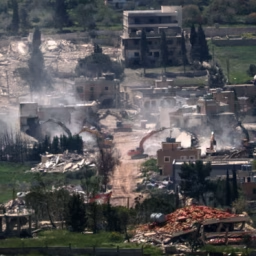


Asia Stocks Iran Tensions Dominate Market Sentiment
The shadow of geopolitical conflict is stretching across global markets once again. Asia stocks Iran tensions took center stage on Thursday as regional equity markets slipped and oil prices climbed, with investors growing increasingly anxious about the continued standoff between Washington and Tehran.
What had been building hopes for a diplomatic breakthrough quickly faded as Iran ramped up activity in the Strait of Hormuz and refused to reopen the critical waterway while the US naval blockade remains in place. The result? A nervous day across Asian trading floors, with oil traders scrambling to price in fresh risk.
Hopes for Peace Talks Fade Fast
Earlier in the week, investors had been feeling cautiously optimistic. Reports suggested that the US and Iran might hold a second round of peace talks in Pakistan, potentially opening the door to resolving a seven-week conflict that has rattled energy markets.
Those hopes, unfortunately, have largely evaporated.
Instead of pursuing dialogue, Iran targeted three container ships moving through the waterway. Iranian forces reportedly seized two vessels and fired on a third, actions confirmed by both global security monitors and Iran’s Revolutionary Guards. Tehran cited the ongoing US naval blockade as justification for its aggressive stance.
The Strait of Hormuz Standoff
Understanding why this matters requires a quick look at the geography. The Strait of Hormuz isn’t just another waterway. During peacetime, it accounts for roughly one-fifth of the world’s oil and gas exports, along with numerous other vital commodities. When tensions rise here, the entire global economy feels it.
Here’s what’s happening in the Strait right now:
- Iran is demanding vessels get permission to enter or leave the Gulf
- Container ships have been seized and fired upon
- The US has maintained a naval blockade that Iran calls a ceasefire violation
- Oil prices have surged as shipping becomes riskier
- Reopening the Strait could take up to six months even after a deal
That last point is particularly alarming for anyone watching commodity markets. Clearing the Strait of mines would take significant time, and such an operation likely wouldn’t even begin until after the broader conflict ends.
Iran’s Position Remains Firm
Iran’s parliament speaker Mohammad Bagher Ghalibaf made the country’s stance crystal clear in a post on X. He declared that a genuine ceasefire loses its meaning when it’s accompanied by a naval blockade, which he described as a blatant violation of the agreement between the two nations.
His bottom line? Reopening the Strait of Hormuz simply isn’t possible while the blockade continues. That position leaves very little room for a quick resolution, and markets are starting to reflect that reality.
The White House Response
On the American side, the messaging has been more measured. The White House has pushed back against characterizing Iran’s actions as a ceasefire violation, noting that the ships involved were not American or Israeli vessels.
Press Secretary Karoline Leavitt added another wrinkle when she told reporters that President Trump has not set a firm deadline for Iran to submit a proposal for talks. According to Leavitt, the timeline for any negotiations will ultimately be determined by the commander in chief himself.
That ambiguity has left markets trying to guess what comes next, which rarely ends well for investor confidence.
Oil Prices Surge on Renewed Fears
The reaction in oil markets was swift and dramatic. Crude prices jumped as much as four percent in early Asian trading after news broke of the ship incidents in the Strait. Brent held above $100 following Wednesday’s surge, though prices pared some of their initial Thursday gains.
At the time of reporting, the key figures looked like this:
- West Texas Intermediate: Up 0.7% at $93.65 per barrel
- Brent North Sea Crude: Up 0.6% at $102.47 per barrel
These aren’t just numbers on a trader’s screen. Elevated oil prices translate into higher costs for transportation, manufacturing, and everyday consumer goods. When crude stays above $100 for extended periods, it tends to squeeze corporate margins and household budgets alike.
Asian Markets Mostly Lower
The equity picture across Asia was mixed but generally gloomy. Most major indices traded lower as investors digested the geopolitical developments and rising energy costs.
Markets that ended in the red included:
- Tokyo’s Nikkei 225, down 1.1% at 58,952.11
- Hong Kong’s Hang Seng, down 0.9% at 25,926.59
- Shanghai Composite, down 0.1% at 4,100.38
- Sydney, Singapore, and Wellington also finished lower
Japan’s Nikkei and the rest of the region retreated from recent peaks, a reminder of how quickly sentiment can shift when geopolitical risks resurface.
South Korea Bucks the Trend
Not every market moved in the same direction, though. Seoul rallied more than one percent to a fresh record high, powered by continued strength in the technology sector that has driven the KOSPI’s impressive year.
Taipei, Manila, and Jakarta also managed to post gains, suggesting that regional strength in tech and select emerging markets could offset some of the broader weakness. When one corner of Asia is riding the AI wave, it can insulate those markets from geopolitical headwinds, at least temporarily.
The SK Hynix Story
A big part of Seoul’s rally came from eye-popping earnings out of South Korean chip giant SK hynix. The company reported a nearly 400 percent jump in net profit, hitting a record for the January through March period. The driver? You guessed it, the ongoing artificial intelligence boom.
This kind of performance from a major semiconductor maker tells you just how much momentum the AI story still has. Even as geopolitical tensions cause turbulence, the underlying demand for chips that power AI systems continues to accelerate.
Earnings Season Offers a Silver Lining
Despite the geopolitical drama, corporate earnings have been providing some much-needed optimism for investors. The numbers are genuinely impressive.
According to Bloomberg, almost 80 percent of S&P 500 companies that have reported first-quarter results have beaten analyst estimates so far. That’s a remarkably strong showing and suggests that American businesses are navigating the current environment better than feared.
Some recent highlights include:
- Tesla announced forecast-topping first-quarter profits
- Texas Instruments delivered a healthy outlook
- SK hynix posted record AI-driven quarterly profits
- Tech sector strength continues to drive broader optimism
These results are helping to offset some of the worry generated by Middle East tensions and rising oil prices.
Analysts Question Market Pricing
Not everyone is convinced that investors are accurately reading the situation, though. Skye Masters from National Australia Bank offered a thought-provoking take on current market behavior.
She noted that there’s limited evidence the rising oil price has dampened bond and equity markets in a meaningful way. Whether that reflects genuine conflict fatigue or confidence that tensions will resolve soon is unclear.
However, Masters raised an important concern. She pointed to reporting from the Washington Post about a senior Defense Department warning that fully clearing the Strait of Hormuz of mines could take six months. Such an operation likely wouldn’t start before the war ends. That’s a substantial timeline, and Masters questioned whether financial markets are correctly pricing in the reality that supply constraints will remain an issue for some time.
A Game Theory Perspective
Raphael Olszyna-Marzys of Bank J. Safra Sarasin offered another angle on the situation. He noted that financial markets appear to be pricing in a high likelihood that traffic through the Strait of Hormuz will soon normalize.
His firm’s game-theory modeling suggests that a narrow agreement to reopen the Strait would actually be in both parties’ best interests. That remains his base case scenario, which is reassuring for investors hoping for a resolution.
However, he added a crucial caveat. Misreading the other party’s intentions could lead to further escalation before any deal is reached. In other words, even if a resolution is ultimately likely, the path there could get bumpier before it gets smoother.
Currency Markets Take It in Stride
While equities and oil grabbed most of the attention, currency markets showed more measured movement. The major pairs traded in relatively tight ranges.
The euro ticked up slightly against the dollar to $1.1710. The pound drifted lower to $1.3501. The dollar slipped modestly against the yen, settling at 159.41. The euro edged higher against the pound at 86.73 pence.
These relatively modest moves suggest that currency traders are taking a wait-and-see approach rather than making dramatic bets in either direction.
What Investors Should Watch Next
Looking ahead, several key factors will determine how the Asia stocks Iran tensions story develops in the coming days and weeks.
The most critical variable is whether actual peace talks materialize. If Iran and the US can find a way back to the negotiating table, markets could rally quickly on optimism. If tensions continue to escalate, expect more volatility in both equities and oil.
Beyond the geopolitical situation, earnings season continues to deliver mostly positive surprises. That underlying corporate health is providing crucial support for markets even as outside risks mount. As long as companies keep beating expectations, there’s a floor under stock prices.
Oil prices deserve constant attention too. If crude stays above $100 for an extended period, the economic impact will start to bleed into inflation readings and central bank decisions, potentially complicating the outlook for interest rates globally.
A Market at a Crossroads
The current moment feels like one of those turning points that investors will look back on with either relief or regret. Asia stocks Iran tensions have created a tricky environment where strong earnings and genuine technological progress are competing with real geopolitical risks.
For now, markets seem to be betting on a relatively quick resolution. Whether that optimism proves well-founded or premature remains to be seen. What’s certain is that the Strait of Hormuz has reclaimed its place as one of the most important chokepoints in global finance, and every headline from the region will continue to move markets.
Investors who can tune out the day-to-day noise while keeping an eye on the bigger picture will likely navigate this stretch best. Those who get caught up in every twist and turn? They might find themselves whiplashed by the rapid shifts in sentiment that geopolitical conflicts tend to produce.
For the moment, the story is still being written. One thing is clear, though. The combination of AI-driven earnings optimism and Middle East-driven anxiety is creating one of the more unusual market environments in recent memory.