

The global energy market took a sharp turn for the worse on Sunday as oil prices surged dramatically following a major geopolitical announcement. What started as a breakdown in diplomatic talks between Washington and Tehran has quickly escalated into a full-fledged crisis that’s rattling financial markets across Asia and beyond.
Trump Announces Iran Blockade, Shocking Markets
In a stunning move that caught investors off guard, US President Donald Trump declared that the American Navy would establish a naval blockade around Iran. The announcement came after ceasefire negotiations collapsed over the weekend, pushing an already fragile situation toward confrontation.
The immediate impact was unmistakable. Brent crude—the global standard for oil pricing—jumped more than 8 percent in a single day, crossing the psychologically critical $100 per barrel mark for the first time since Tuesday, when prices had briefly topped $111. This represents a dramatic escalation from just days earlier when crude was trading below $92 a barrel.
Washington Clarifies Scope, But Concerns Remain
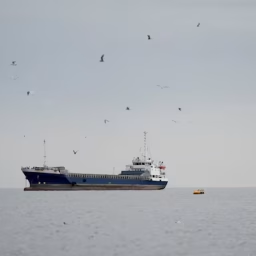
While Trump’s initial announcement suggested a complete blockade of the Strait of Hormuz—one of the world’s most strategically vital waterways—US Central Command walked back the rhetoric slightly. Officials clarified that the blockade would specifically target vessels traveling to and from Iran, while allowing other international traffic to pass through.
The blockade officially took effect on Monday at 10am Eastern Time, but the damage to market confidence had already been done.
Why This Matters: The Strait’s Critical Role
To understand the gravity of this situation, consider this: the Strait of Hormuz handles roughly one-fifth of all global oil and natural gas supplies. Any disruption here doesn’t just affect Iran or the US—it reverberates through the entire world economy.
The tensions have been building for weeks. After a series of US-Israeli strikes on Iranian targets, Tehran responded by imposing its own de facto blockade on the strait. Oil prices initially skyrocketed to $119 per barrel in reaction.
Just when things seemed to be stabilizing—with both sides agreeing to a two-week ceasefire on April 6—the diplomatic channels suddenly collapsed. The ceasefire was supposed to last until April 22, but that timeline now appears uncertain.
Shipping Grinds to a Halt
The real-world impact is already visible in shipping traffic data. Before the escalating tensions, the strait saw approximately 130 vessels transit daily under normal peacetime conditions.
Today, that number has plummeted to just a trickle.
On Saturday alone, only 17 vessels crossed the strait, according to maritime intelligence firm Windward. While Iran has technically allowed some ships through—subject to government vetting and prior authorization—the dramatic reduction in traffic tells the story of an energy market under siege.
Asian Markets React with Sharp Declines
The uncertainty rippled instantly through financial markets worldwide. Asian stock exchanges opened Monday morning with notable losses:
- Japan’s Nikkei 225 fell 0.9 percent during morning trading
- South Korea’s KOSPI dropped more than 1 percent
- US stock futures also declined, with S&P 500 futures down approximately 0.8 percent
These moves reflect investor anxiety about what comes next—higher energy costs, supply chain disruptions, and the broader geopolitical risks that make long-term planning nearly impossible.
What’s Next?
The oil market remains unusually volatile. Prices have swung wildly over the past month—from $119 to $92 and now back above $103—leaving traders and analysts struggling to predict what comes next. Every headline from Washington or Tehran now moves markets by billions of dollars.
For consumers at the gas pump, businesses dependent on energy, and investors with significant holdings, the next few days could prove crucial in determining whether this becomes a sustained crisis or a temporary spike in tensions.
The coming weeks will test whether diplomacy can still bridge the gap between the two nations, or whether the world has entered a new, more dangerous phase of energy market instability.