

Oil markets are holding their breath this weekend as the second round of U.S.-Iran talks kicks off in Islamabad, with the future of the Strait of Hormuz hanging in the balance. After 45 days of blockade, traders, governments, and ordinary consumers are all watching to see whether diplomacy can deliver relief or whether the world is about to face a serious energy crunch.
Prices have already started to reflect cautious optimism, with ICE Brent sliding back below $90 per barrel following some encouraging signals from Tehran and a fragile Israel-Lebanon ceasefire brokered by the Trump administration. But the path from here is anything but certain, and the stakes could hardly be higher.
The Hormuz Situation: Open, Closed, or Somewhere In Between
Iran’s messaging on the Strait of Hormuz has been a study in mixed signals. Foreign Minister Abbas Araghchi announced that navigation through the strait is completely open for the remainder of the ceasefire period, a statement that initially sent oil prices tumbling and sparked relief across global markets.
Almost immediately, however, Iran’s Revolutionary Guard Corps pushed back, reiterating that any tankers transiting the strait would still need to coordinate directly with them. That kind of contradiction leaves shipping companies, insurers, and traders unsure of what the real situation on the water actually looks like.
This confusion matters because the Strait of Hormuz is arguably the single most important chokepoint in global energy. Roughly a fifth of the world’s oil passes through this narrow waterway, and any disruption ripples through prices around the globe within hours.
What’s Happening This Weekend in Islamabad
The second round of U.S.-Iran talks in Islamabad represents what many analysts are calling a make-or-break moment for oil markets. If negotiators can find common ground, the blockade may ease and prices could continue to retreat. If talks collapse, the International Energy Agency’s warnings about impending fuel shortages and demand collapse could quickly become reality.
The Israel-Lebanon ceasefire, while still shaky, has given diplomats some momentum to work with. Trump’s ability to broker that agreement has shifted the broader atmosphere, creating at least the possibility that more ambitious deals might be within reach.
Traders are positioning themselves accordingly, and volatility is expected to remain high over the coming days as headlines emerge from the talks.
The US Tightens the Screws on Chinese Banks
Even as diplomacy plays out on one front, the Treasury Department is ramping up pressure on another. The U.S. has sent warning letters to two Chinese banks, cautioning them about potential sanctions if they are found processing Iranian oil payments.
The campaign has been given a dramatic name: Operation Economic Fury. This is not just rhetoric. It signals that Washington is prepared to punish foreign financial institutions that facilitate Iranian oil trade, a move that could significantly complicate Beijing’s ability to keep buying discounted Iranian crude.
Speaking of China, the country’s domestic oil producers are responding to Gulf supply disruptions by ramping up their own production. Chinese crude output hit 4.51 million barrels per day in March, up 1.3 percent year-over-year, marking the highest ever monthly production. When Gulf supplies look uncertain, China is clearly choosing to pump harder at home.
Australia’s Fuel Supply Takes Another Hit
Bad news continues to pile up for Australian drivers. The 120,000 barrel-per-day Geelong refinery, operated by Viva Energy, suffered a devastating fire this week. The blaze hit the plant’s gasoline-producing units specifically, potentially leading to a 45,000 barrel-per-day gasoline supply loss over the coming weeks.
For Australian consumers, this means tighter supplies and likely higher prices at the pump, stacking pain on top of already elevated global oil prices. The Geelong fire is a stark reminder that even domestic refining infrastructure can be disrupted unexpectedly, adding yet another risk factor to the supply picture.
A Pakistani Tanker Breaks Through the Counter-Blockade
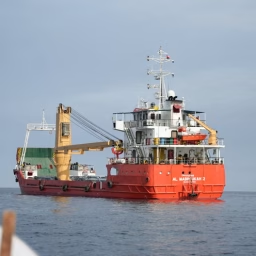
In a development that may signal shifting momentum, a Pakistani-owned crude tanker named Shalamar became the first ship to export crude out of the Strait of Hormuz and the Arabian Sea since the current standoff began. The vessel loaded a 450,000-barrel cargo at the UAE’s Das Island and is now en route to Karachi.
This breakthrough could pave the way for other shippers to follow, gradually reopening trade routes that have been effectively frozen. Whether this becomes a trickle or a flood will depend largely on how the weekend’s talks unfold.
Iran’s Staying Power
Despite the squeeze, Iran is not immediately desperate. Analysts estimate that Iranian oil producers can withstand a complete halt in exports for up to two months before being forced to shut in actual crude production. This is thanks to roughly 90 million barrels of available storage capacity that can absorb production while exports remain blocked.
This buffer gives Tehran some negotiating leverage. Iran does not need to accept bad terms immediately, though the clock is ticking. Two months of zero exports would still cause enormous economic damage, even if production itself continues.
OPEC Posts Historic Production Drop
Meanwhile, OPEC as a whole is experiencing massive output declines. The organization’s crude production plunged by 7.88 million barrels per day last month, reaching 20.79 million barrels per day. That is the steepest monthly drop in OPEC’s history, driven largely by Iraq, which posted the largest single-country production cut at 2.56 million barrels per day.
This scale of decline is staggering and reflects the broader regional instability affecting Gulf producers. Combined with the Hormuz blockade, it paints a picture of a Middle East oil sector under serious strain.
IEA Warns of a Long Recovery Ahead
International Energy Agency chief Fatih Birol has delivered a sobering assessment. Even if tensions ease soon, the Middle East would need at least two years to recover and reach pre-war levels of oil and gas production. Cash-strapped countries like Iraq will face the steepest climb, as they lack the financial resources to quickly rebuild damaged infrastructure.
This long recovery timeline suggests that even a diplomatic breakthrough this weekend would not immediately restore pre-crisis supply levels. The effects of this period will be felt in oil markets for years to come.
India Backs Away From Iranian Oil
India, long one of the largest buyers of Iranian crude, is now pulling back. After importing two very large crude carrier cargoes during Trump’s 30-day sanctions waiver, India’s refiners have rejected any further shipments. Reliance, the country’s largest private refiner, has refused to discharge two cargoes citing compliance issues.
This pullback matters because India represents one of the few remaining markets where Iran could sell significant volumes. If Indian refiners are walking away, Iran’s export options continue to narrow.
Nigerian Airlines Face Fuel Crisis
The ripple effects of high oil prices are hitting aviation hard. Nigeria’s airline industry group Aon has threatened to suspend all domestic flights starting April 20 in protest at the tripling of jet fuel prices. Kerosene prices have climbed to 3,000 naira, roughly $2.23 per liter, making operations financially unsustainable for many carriers.
This kind of ground-level impact shows how quickly energy shocks cascade through entire economies. When jet fuel triples in price, flights get grounded, passengers get stranded, and local economies feel the pain almost immediately.
Deal-Making Continues Behind the Scenes
Even amid the chaos, major oil deals are being struck. Trading house Trafigura has agreed to a $1 billion oil-backed loan with Gabon, providing upfront funds in exchange for exclusive rights to market the country’s profit oil for seven years. This kind of deal deepens Gabon’s dependence on traders but also provides much-needed cash for the OPEC member.
In Angola, national oil company Sonangol is negotiating with neighboring Botswana on a potential stake sale in the $5.6 billion Lobito refinery. Once online in late 2027, the facility is expected to handle 200,000 barrels per day, adding meaningful refining capacity to southern Africa.
Setbacks for Oil Majors
Not every story in the oil world this week was about supply and demand. Oil majors operating Kazakhstan’s giant Kashagan field lost another court appeal against an environmental fine of roughly $5 billion for storing excessive sulphur. Eni, TotalEnergies, and Shell are now left with international arbitration as their only remaining path forward.
ExxonMobil also hit a stumbling block, withdrawing its offer to sell the first two cargoes from its Golden Pass LNG project. The plant has reportedly been running at only a third of its capacity since late March, taking in an average of 290 million cubic feet per day this week. For a project meant to help diversify global LNG supply, this slow start is not ideal.
China Weaponizes Solar Exports
In a potential sign of broader economic tensions, Beijing is considering limiting exports of advanced solar technologies to the United States. Chinese authorities have held initial talks with domestic solar equipment producers about export curbs.
Given that China controls roughly 80 percent of global solar component production, any such restrictions would have major implications for U.S. renewable energy deployment. It is another front in the broader strategic competition between the two superpowers, playing out alongside the oil market drama.
What to Watch This Weekend
For oil traders, consumers, and governments around the world, the next 48 to 72 hours could set the direction of energy markets for months to come. The key questions to watch include:
- Whether the Islamabad talks produce any kind of breakthrough
- Whether Iran clarifies its position on Hormuz transit
- Whether more tankers follow the Pakistani vessel through the strait
- Whether the Israel-Lebanon ceasefire holds under pressure
- Whether additional sanctions or diplomatic moves are announced
Oil markets are fundamentally driven by expectations, and expectations can shift rapidly based on a single headline. A positive announcement from Islamabad could send Brent back toward the low $80s. A breakdown could send it surging back above $100 within hours.
The Bigger Picture for Global Energy
Beyond the immediate crisis, the events of the past 45 days have exposed just how fragile the global energy system remains. Despite years of investment in renewables, efficiency improvements, and supply diversification, a single regional conflict can still send shockwaves through every economy on the planet.
The long-term lessons from this period will take time to digest, but some are already becoming clear. Diversification of supply sources matters enormously. Strategic petroleum reserves provide critical buffers. And geopolitical risk can never be fully priced out of energy markets.
For now, all eyes are on Islamabad. Whatever happens this weekend will reverberate through oil markets, financial markets, and everyday consumer prices for weeks and months to come. In a world this interconnected, a single round of talks really can change everything.