

Global Markets React to Escalating Tensions in the Strait of Hormuz
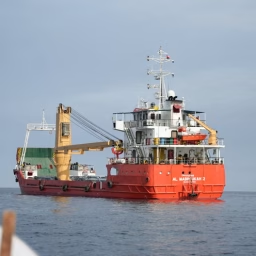
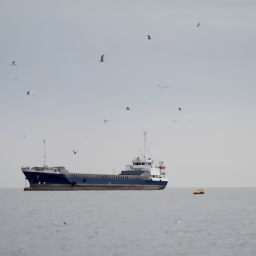
Oil prices surged sharply during Monday’s early trading hours in Asia after US President Donald Trump announced that American forces had intercepted and seized a cargo vessel flying the Iranian flag. The development has sent shockwaves through global energy markets, reigniting fears of a prolonged supply crisis in one of the world’s most critical shipping corridors.
This latest move follows Tehran’s weekend announcement that it would once again shut down the Strait of Hormuz to commercial shipping, warning that any vessel attempting to pass through would be treated as a target.
Oil Prices Climb on Fresh Geopolitical Shock
The market response was swift and decisive. Brent crude futures climbed by 4.74 percent to reach 94.66 dollars a barrel, roughly 70.11 pounds in sterling terms. Meanwhile, West Texas Intermediate rose even more sharply, gaining 5.6 percent to trade at 88.55 dollars per barrel.
Since the US and Israeli strikes on Iran began on 28 February, energy markets have been caught in a cycle of sharp swings. Tehran’s repeated threats to disrupt shipping through the Strait of Hormuz have kept traders on edge, particularly given that nearly 20 percent of the world’s oil and liquefied natural gas supply passes through this narrow waterway each day.
Diplomatic Efforts Stall Amid Rising Tensions
President Trump had earlier indicated that American representatives would travel to Pakistan on Monday to engage in fresh negotiations. A White House official confirmed that Vice-President JD Vance would head the US delegation for these talks.
However, Iran’s state-run media reported that Tehran currently has no intention of joining the discussions. Iranian government officials have so far declined to provide any formal clarification of their country’s stance, leaving the diplomatic path uncertain.
Saul Kavonic, an analyst at financial services firm MST Marquee, told the BBC that the current market volatility reflects more than just fundamental supply concerns. In his view, oil markets are swinging in response to a steady stream of social media activity from both Washington and Tehran, rather than the genuine situation on the ground, which continues to pose serious obstacles to any swift recovery of oil flows. He described the tense standoff as a negotiation being played out live along the Strait of Hormuz.
The Strait of Hormuz Remains a Flashpoint
The Strait of Hormuz stayed closed throughout Sunday. This came after the Islamic Revolution Guard Corps, known as the IRGC, declared it was ending what had been a brief reopening of the waterway. According to Iranian authorities, the US naval blockade amounted to a violation of their ceasefire agreement, and they insisted the strait would remain closed until Washington lifted the blockade.
Trump, for his part, stated on Friday that the blockade would continue until both nations reached a formal agreement.
Key Points About the Strait of Hormuz Crisis
- Roughly 20 percent of the world’s oil and LNG shipments pass through this waterway.
- Iran insists the strait will stay closed until the US ends its naval blockade.
- The US maintains that the blockade will remain in place until a deal is signed.
- Market analysts warn that oil flows are unlikely to recover quickly.
A Dramatic Swing in Energy Prices
Energy markets have experienced some of their most turbulent trading in years since hostilities between the US, Israel, and Iran began. Prior to the conflict, Brent crude, a widely followed global benchmark, was trading at under 70 dollars per barrel. By 9 March, it had soared to nearly 120 dollars, a staggering increase in just a matter of weeks.
For readers unfamiliar with the terminology, futures contracts represent agreements to buy or sell a specific asset at a predetermined price on a future date. The Brent futures contract being referenced here is set for crude oil delivery in June.
A Global Energy Crisis Unfolds
The conflict has triggered a full-blown energy crisis with ripple effects reaching far beyond the Middle East. Sharp price hikes are being felt worldwide, and several nations are now grappling with fuel shortages.
Asia has borne the brunt of the fallout. The region depends on shipments travelling through the Strait of Hormuz for approximately 90 percent of its energy requirements, making it uniquely vulnerable to any disruption there.
How Asian Governments Are Responding
Faced with dwindling supplies, governments across Asia have rolled out a range of conservation measures. Some of the most notable steps include:
- Ordering public sector employees to work from home to reduce commuting fuel use.
- Shortening the official working week to save on energy consumption.
- Declaring national holidays to limit business activity temporarily.
- Closing universities earlier than planned to conserve electricity and fuel.
Several Southeast Asian nations, including Singapore and Thailand, have urged citizens to reduce their reliance on air conditioning, a significant energy consumer in the region’s hot and humid climate.
Even China, widely believed to hold oil reserves equivalent to roughly three months of imports, has been forced to make adjustments. Authorities have capped a fuel price hike to soften the blow for consumers, though citizens are still facing a roughly 20 percent jump in prices at the pump.
Aviation Industry Under Pressure
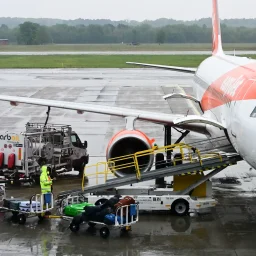
Airlines across Asia have introduced emergency measures to cope with the skyrocketing cost of jet fuel. The aviation sector, already sensitive to fuel price fluctuations, is particularly exposed during this crisis.
The situation in Europe is also looking increasingly dire. Last week, Fatih Birol, head of the International Energy Agency, issued a stark warning that Europe may have only about six weeks of jet fuel remaining. He cautioned that if supplies continue to be blocked, flight cancellations could soon become unavoidable.
Some Relief in the UK
There has been a small glimmer of good news closer to home. In the United Kingdom, petrol and diesel prices eased slightly toward the end of last week after a run of consecutive increases. While this offers modest relief for motorists, analysts caution that the reprieve could be short-lived if the standoff in the Middle East continues to escalate.
What Comes Next?
The situation remains highly fluid, with every statement from Washington or Tehran capable of sending markets lurching in either direction. For now, the combination of a seized Iranian vessel, a closed Strait of Hormuz, and stalled diplomatic talks suggests that oil price volatility is here to stay.
Investors, businesses, and ordinary consumers alike will be watching closely to see whether Monday’s planned negotiations in Pakistan can break the deadlock, or whether the coming weeks will bring further shocks to an already strained global energy system.
As analyst Saul Kavonic noted, this is essentially a negotiation happening in real time, with every move in the Strait of Hormuz shaping the next price swing. Until a genuine breakthrough is reached, markets will remain hostage to the evolving headlines.